QANM members are naturopathic doctors trained and examined across core competency domains: biomedical sciences and diagnostics, clinical nutrition and lifestyle medicine, pharmacology interactions, evidence-informed therapeutics, gentle therapies, and patient-centred case management.
board examination
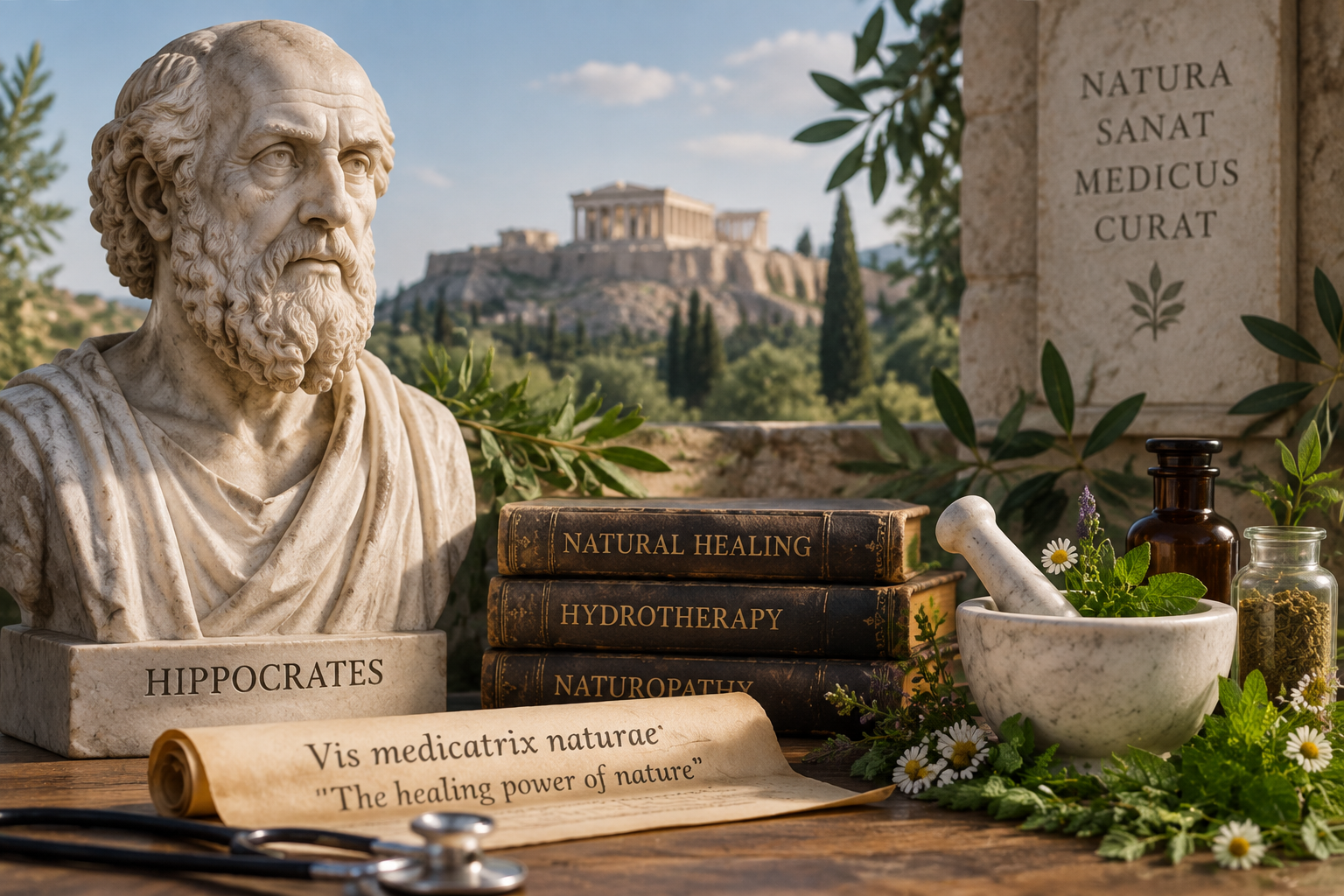
Naturopathic medicine’s founding principle — vis medicatrix naturae, “the healing power of nature” — traces back to Hippocrates, the Greek physician (c. 460–370 BCE) regarded as the father of Western medicine, who held that rest, diet, fresh air, and cleanliness support the body’s own capacity to heal.¹
The modern profession took shape in 19th-century Europe’s nature-cure movement, built on hydrotherapy and lifestyle-based healing popularized by practitioners such as Sebastian Kneipp. The term “naturopathy” was coined in 1895 by German physician John Scheel, and adopted in 1901 by Benedict Lust — a German-trained hydrotherapist who brought the practice to the United States. Lust founded the American School of Naturopathy in New York, graduating its first class in 1902, and organized practitioners into the Naturopathic Society of America.²
Naturopathic practice was well established in Canada by 1920. Provincial regulation followed early in several jurisdictions: Ontario (1925), British Columbia (1936), Manitoba (1943), and Saskatchewan (1952). The Canadian Association of Naturopathic Doctors (CAND) has represented the profession nationally since 1955.³
The profession lost ground through the mid-20th century as antibiotics, surgical advances, and the growth of the pharmaceutical industry shifted healthcare’s centre of gravity. Formal Canadian naturopathic education re-established itself in 1978 with the founding of the Ontario College of Naturopathic Medicine in Toronto, which expanded to a full four-year doctoral program by 1983 and became the Canadian College of Naturopathic Medicine (CCNM) in 1992. The Boucher Institute of Naturopathic Medicine opened in British Columbia in 2000.⁴ Over the past several decades, growing public interest in preventive, whole-person care has driven renewed demand for naturopathic services across North America — the same demand QANM represents in Quebec today.
The Council on Naturopathic Medical Education (CNME) is the recognized accrediting body for naturopathic medical education in North America. CNME accredits four-year,post-graduate, degree-granting programs
Toronto, ON & New Westminster, BC · ccnm.edu
Kenmore, WA & San Diego, CA · bastyr.edu
Portland, OR · nunm.edu
Portland, OR · nunm.edu
Tempe, AZ · sonoran.edu
Gurabo, Puerto Rico · uagm.edu
Naturopathic education combines four years of biomedical and clinical science with training across natural therapeutic disciplines:
Diet and nutrient-balance protocols as part of the core curriculum.
Pharmacology and clinical application of plant-based medicines.
Theory and clinical training in homeopathic case-taking and prescribing.
Manual therapy training as part of the clinical practicum
Behavioural-change methodology as a distinct training component.
Physical exams, lab testing, and diagnostic imaging interpretation
NPLEX is administered by the North American Board of Naturopathic Examiners (NABNE). It consists of Part I (Biomedical Science) and Part II (Core Clinical Science), plus optional clinical elective exams. Registration is through nabne.org.
In 2023, CANRA has embarked on establishing a new National Entry-to-Practice Competency Profile which includes 22 key competencies and 62 enabling competencies in five domains: professionalism, communication, assessment and diagnosis, therapeutic management, and records management. As of April 2019, Ontario was the first province to begin a pilot-project adopting their own entry-to-practice examinations and Prior Learning and Assessment Recognition (PLAR) to include qualified professionals who successfully meet and pass the criteria for entry into the profession.This entry-to-practice examination has replaced NPLEX in Ontario.
No CNME-accredited program currently exists in Quebec. QANM supports the development of a French-language naturopathic medical program and to assist in setting the standard for educational and entry-to-practice standards.